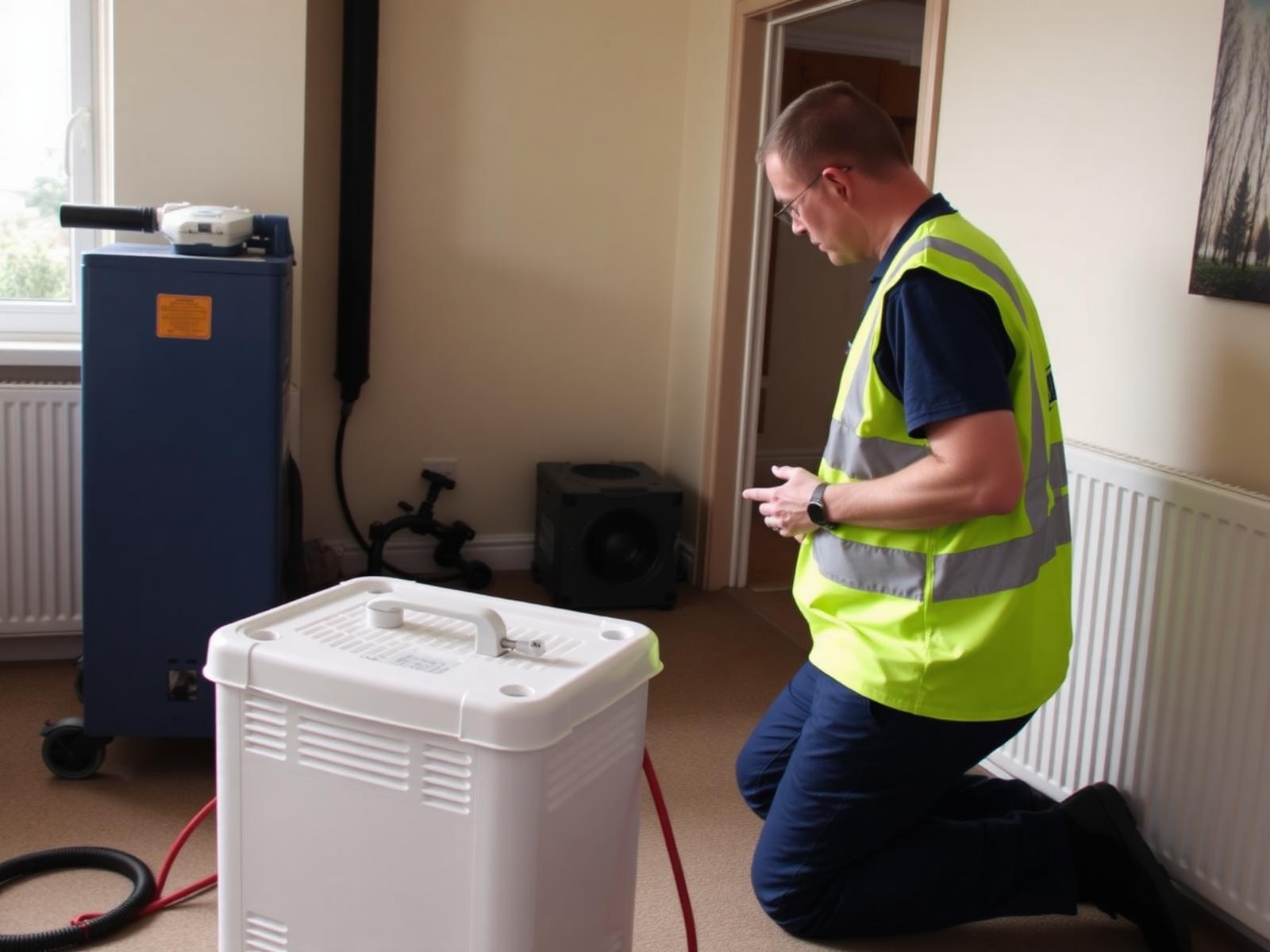
Visible flood water disappears quickly. Trapped moisture in plaster, screeds, insulation, timber and behind finishes does not. Within 24 to 72 hours of wetting, common moulds such as Aspergillus and Penicillium can begin to colonise damp cellulose-rich surfaces. Stachybotrys and Chaetomium follow where wetting is sustained over days or weeks. Testing characterises that risk objectively and supports decisions about what can be dried in place and what must be removed.
01
Why post-water-damage testing matters
02
Typical scenarios
Burst pipes and tank failures in flats and houses. Roof leaks following storms. Washing machine and dishwasher failures. Surface and groundwater flooding. Façade ingress in commercial buildings. Construction water trapped behind early finishes. Each scenario produces a different moisture distribution, and the survey adapts accordingly.
03
How the investigation runs
The first visit documents the extent of wetting. Moisture meter readings, thermal imaging and RH/T measurements map the affected area, including locations not visibly damp where moisture has tracked behind skirtings, into floor zones or up wall voids. Where occupancy needs to be restored quickly or where hidden colonisation is suspected, airborne spore-trap samples are taken alongside surface tape lifts on any visible growth.
Findings are shared with the drying contractor, loss adjuster and owner so that scope decisions — drying in place versus strip-out — are made on evidence.
04
Post-drying clearance testing
Once drying is complete and any remediation has been carried out, clearance testing verifies that moisture readings have stabilised and airborne spore counts have returned to outdoor-reference levels. Clearance is the point at which re-occupation, redecoration and reinstatement can proceed with confidence.
05
What clearance does and does not cover
Clearance testing confirms the conditions present at the time of sampling. It is not a warranty against future water damage. Where the cause of the original event — defective plumbing, failed roofing, inadequate flashing — has not been addressed, recurrence is likely regardless of the clearance result. Reports state this explicitly.
06
Frequently asked questions
How soon after a leak or flood should testing happen?
An initial inspection is best within the first few days so the moisture extent is documented while it is still measurable. Clearance testing follows after drying and any remediation is complete.
Will testing tell me whether the building is fully dry?
Moisture meter and RH/T readings are used to confirm drying. Mould testing complements drying records by confirming whether airborne spore counts have returned to outdoor-reference levels.
What if mould is found behind finishes?
Where hidden colonisation is confirmed, the affected porous materials normally need to be removed under containment rather than cleaned in place. The report sets out the scope clearly.
Do you coordinate with drying and remediation contractors?
Yes. We work alongside loss adjusters, drying technicians and remediation contractors, and time clearance sampling to fit the project programme.